


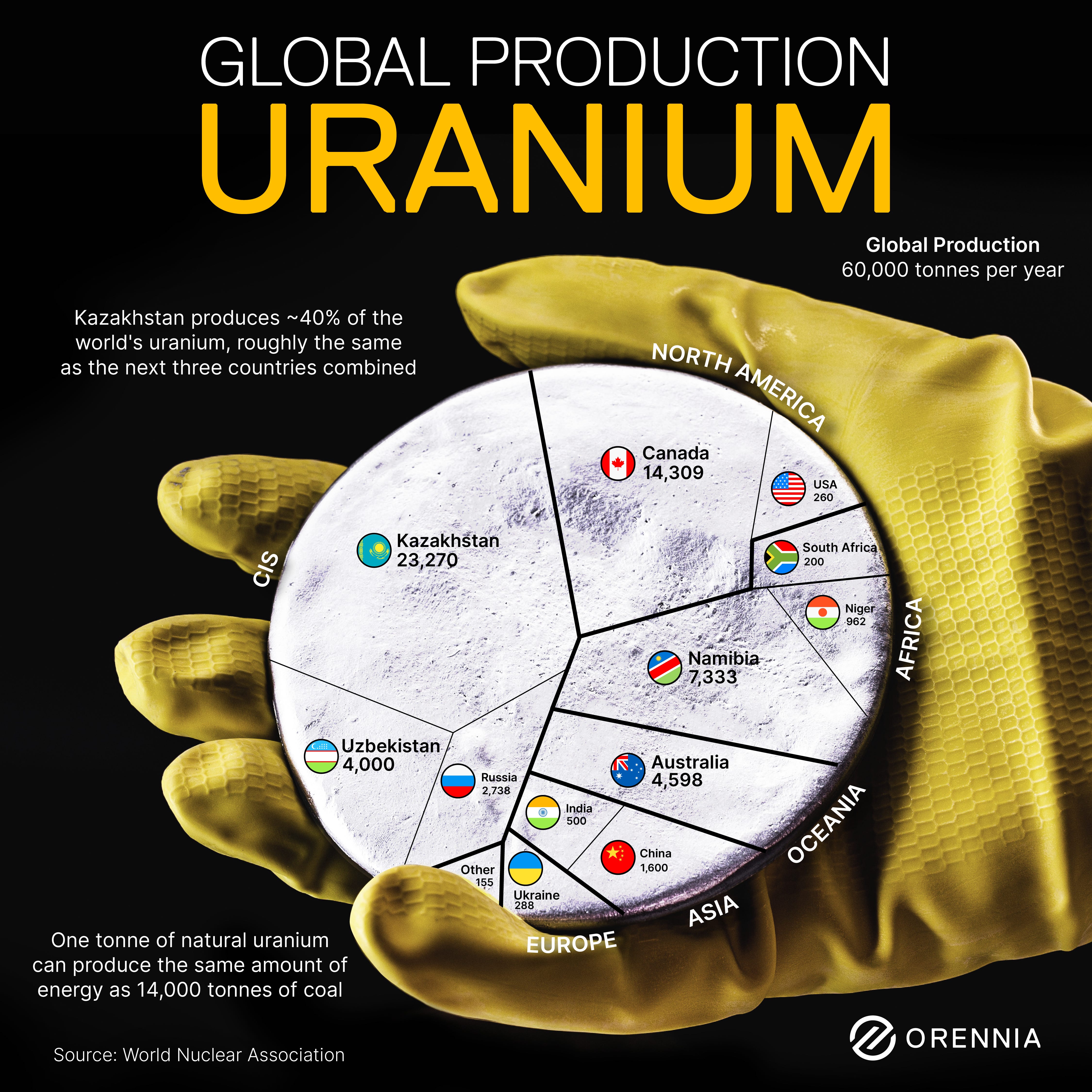
Uranium is the backbone of nuclear power and comes from a surprisingly concentrated set of regions. While deposits exist on every continent, commercial-scale mining is dominated by just a handful of countries with large sedimentary basins and sandstone-hosted ores that can be extracted cheaply.
Today, nearly 60,000tonnes of uranium are produced annually, with most of it originating from Central Asia, North America and southern Africa.
Kazakhstan: The world’s uranium powerhouse, supplying roughly 40% of global output through extensive low-cost in-situ recovery operations.
Canada: Contributes some of the highest-grade uranium on Earth, with the Athabasca Basin serving as the backbone of Western nuclear fuel supply.
Namibia: Africa’s leading uranium producer, anchored by massive, long-life open-pit operations like Rossing and Husab.
The global uranium supply gap: Reactors worldwide are consuming more uranium each year than miners produce, forcing utilities to draw from stockpiles and secondary sources, like old weapons material, reprocessing and inventories). After a decade of underinvestment and low prices, mining has lagged demand, setting up the tightest market in more than 15 years.
Written by Aaron Foyer, Vice President of Research and Analytics at Orennia
✉️ As always, feel free to reach out to me at aaron.foyer@orennia.com